
What if getting from A to B wasn't just a means to an end, but the experience itself?
That's the question 360Channel set out to answer when they built 360maps, a WebAR navigation tool, built with Zappar's Mattercraft tool that turns the simple act of moving through a space into something closer to play. Recently deployed at the Ghost in the Shell Exhibition at Tokyo's Toranomon Hills Station Tower, 360maps didn't just show visitors where to go; it pulled them into one of the world's most iconic sci-fi universes, scene by scene, step by step.
Before we dive in...
It's worth pausing here, because indoor navigation is having a moment. Our own Zapworks Spaces tackles a similar problem from a very different angle: it's built for facilities teams, workplaces, and public venues that need a reliable, accessible wayfinding for everyone, including people who are blind or low vision. Spaces is about independence, confidence, and getting people to that meeting room, that hospital ward, or that piece of machinery quickly and easily, without friction.
360maps takes the same underlying problem and asks something different: what if navigation could be the entertainment? Where Spaces removes friction so people can get on with their day, 360maps adds intention so people slow down, look around, and lose themselves in a story.
Why AR?
Big exhibitions in big buildings have a navigation problem. Static signage and 2D floor plans only get you so far in complex spaces, and during a major event, crowds tend to clump in some areas while other parts of the venue go quiet. The result is bottlenecks in one wing, missed content in another, and visitors who never quite see everything they came for.
The Ghost in the Shell franchise has spent decades building one of the densest, most cohesive visions of a networked future in science fiction. Cyberisation, hyper-connected cities, blurred lines between digital and physical — it's a universe practically designed to be experienced in AR. So instead of treating navigation as a separate, functional layer sitting awkwardly on top of the experience, 360Channel asked: what if wayfinding was part of the world?
The objectives were simple:
- Make a complex venue genuinely easy to navigate
- Pull visitors deeper into the franchise's universe rather than yanking them out of it
- Spread footfall more evenly across the space and rescue underused areas
- Generate the kind of social and media moments that turn a one-off visit into wider brand reach
AR earned its place here because the medium and the message lined up. A networked, sci-fi future is exactly the kind of story that benefits from digital layers blooming into the real world on cue.
The experience
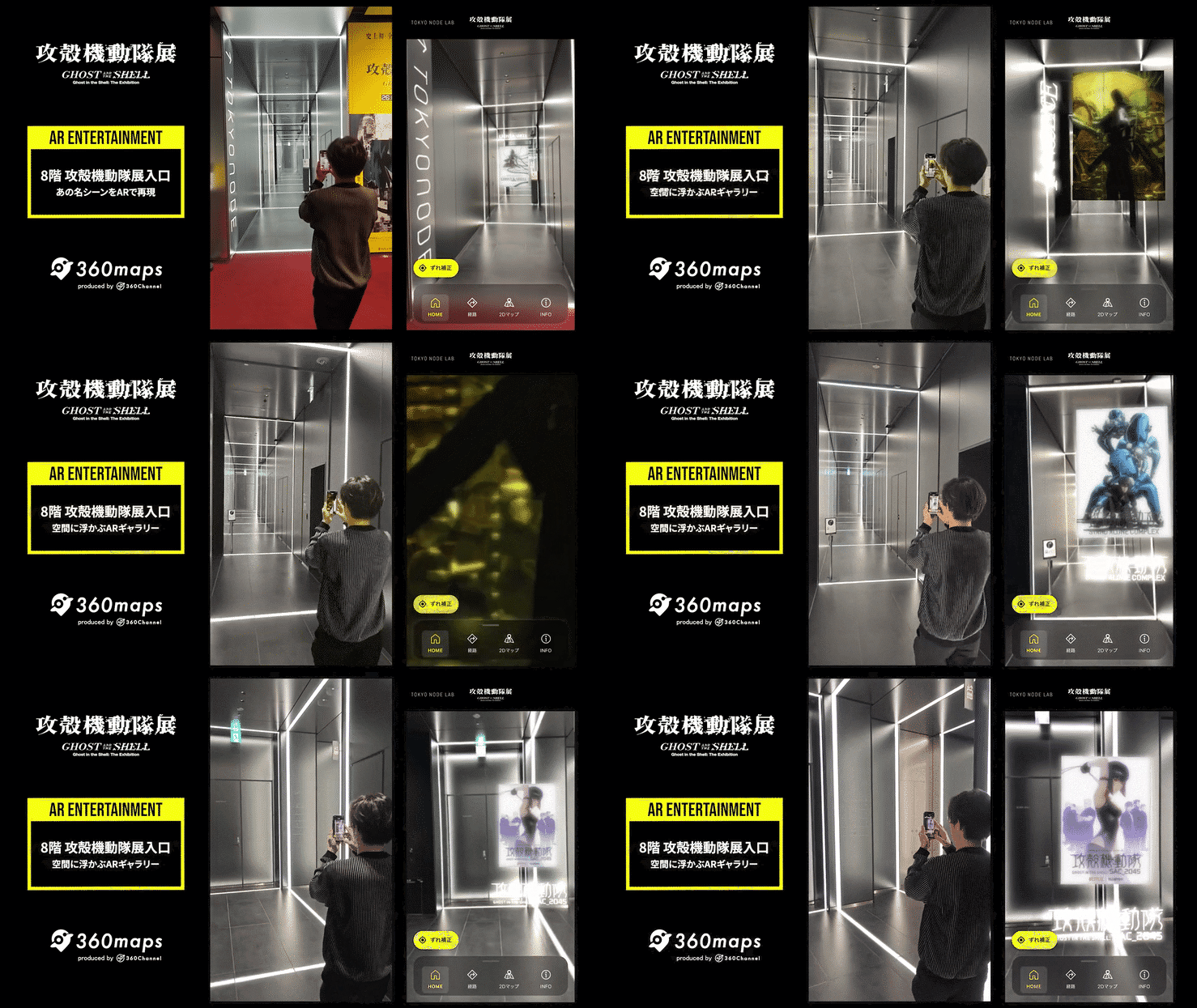
A visitor arrives at Toranomon Hills Station Tower, scans a QR code on a piece of on-site signage, and the experience opens directly in their phone's browser. No app store. No download. No "please update to continue." A 3D AR route appears, plotting the way from the lower floors of the building up to Tokyo Node Gallery, where the exhibition itself lives.
Once the experience launches, two things happen at once. A 3D route appears overlaid on the real world through the phone's camera, guiding the visitor toward their destination. And as they move, AR content drawn from the exhibition's visual language begins to surface around them, growing, drifting, transforming. Less "you have arrived at your destination" and more "you have arrived inside the story."
It's not a gimmick layered on top of a map. The map is the gimmick, and the gimmick is also the navigation, and somehow it all works because every piece is in service of the same idea: a future world made accessible through the screen in your hand.
There's also a part of this project that, frankly, deserves its own headline. 360Channel partnered with Honda, KDDI, Mori Building, and CinemaLeap to integrate 360maps with UNI-ONE, Honda's seated mobility robot, and not just any UNI-ONE. For this collaboration, the device was painted in the livery of the Tachikoma, the much-loved AI-driven walker tank from Ghost in the Shell.
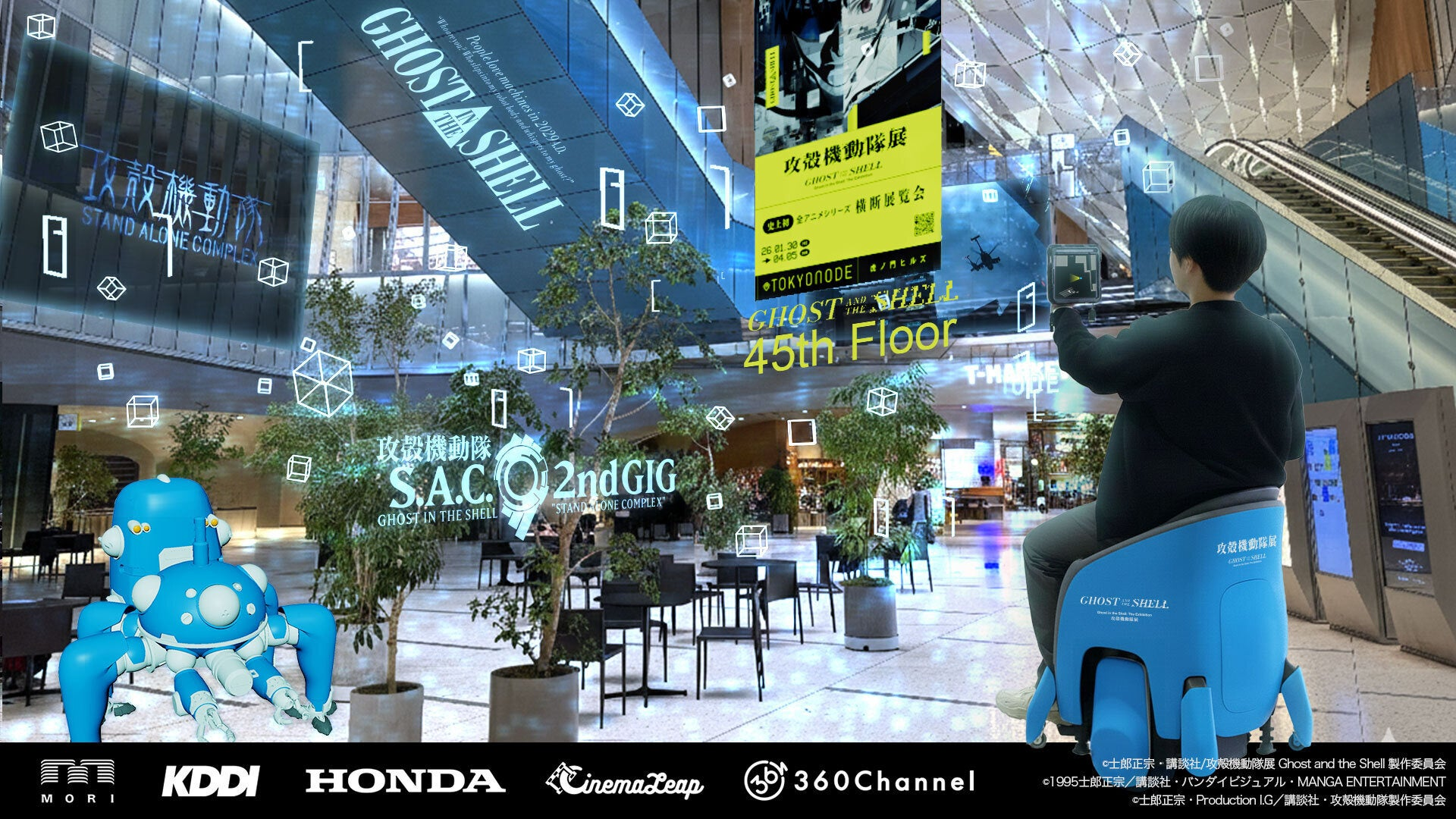
Visitors leaned in the direction they wanted to travel, the UNI-ONE responded, and the AR navigation synchronised with the device's movement in real time. The result was Japan's first rideable AR navigation experience, where visitors didn't just walk through the world, they piloted through it.
A story that travels with you
One of the smartest decisions 360Channel made early on was to stop thinking about each AR moment as an isolated activation and start thinking about the venue as a single, continuous spatial system.
Simply put, this meant that the experience wasn't a series of disconnected "scan here" moments but a much more coherent journey that responds to where you are, where you've been, and where you're heading. The AR layer pays attention to the visitor's trajectory through the space, not just their proximity to a single trigger.
To pull that off, the team navigated some real creative challenges:
- Holding accurate indoor positioning across a sprawling, GPS-dead complex with mixed lighting and architectural quirks
- Designing transitions between the 2D map view and the full AR view that felt natural rather than jarring
- Synchronising AR visuals with the physical movement of the UNI-ONE closely enough that nothing felt "off" — even half a second of drift between rider and visuals breaks the illusion
- Keeping the experience usable for first-time visitors with zero onboarding, because nobody reads instructions at an exhibition
Restraint mattered as much as ambition. Every AR moment had to earn its place by either helping someone move through the venue or pulling them deeper into the world. Anything that didn't do at least one of those got cut.
The tech behind the magic
From a technical standpoint, this is a strong demonstration of what WebAR can do when it's pushed at scale.
The team built the experience on Mattercraft, our most advanced creative tool for immersive 3D web content, deploying directly to the browser without sacrificing visual fidelity. That browser-first approach mattered for a venue expecting tens of thousands of visitors across the campaign window.
The stack included:
- Mattercraft for building, optimising, and deploying the experience to the web
- MultiSet Visual Positioning System (VPS) for precise indoor location tracking where GPS isn't an option
- Spatial scanning data to anchor AR content accurately within the real-world environment
- 3D modelling and animation tools for creating assets that matched the franchise's visual language
- 5G connectivity on-site to keep rich AR assets streaming with low latency
- Iterative testing inside the actual venue — because no virtual test rig fully replicates a busy exhibition floor
360maps project is a strong example of how Mattercraft serves as a foundational toolkit for complex, multi-layered experiences, especially when you need to integrate third-party libraries, external services, and custom hardware into a single WebAR build.
The results
Across the campaign window, 360maps:
- Attracted several thousand users despite a limited run
- Hit an average engagement time of 169 seconds, around 2.2x the industry benchmark
- Drove visitors into previously underused parts of the venue, confirmed by heatmap analysis of foot traffic
- Earned coverage from major national media across both business and tech press
- Maintained a high activation rate thanks to the app-free, instant-access design
That last point is easy to gloss over but worth dwelling on. Activation rate is where most AR campaigns quietly fail. A beautiful experience nobody can be bothered to launch is a beautiful experience nobody sees. By keeping the entry point to a single QR scan, 360Channel removed the most common point of failure in AR distribution.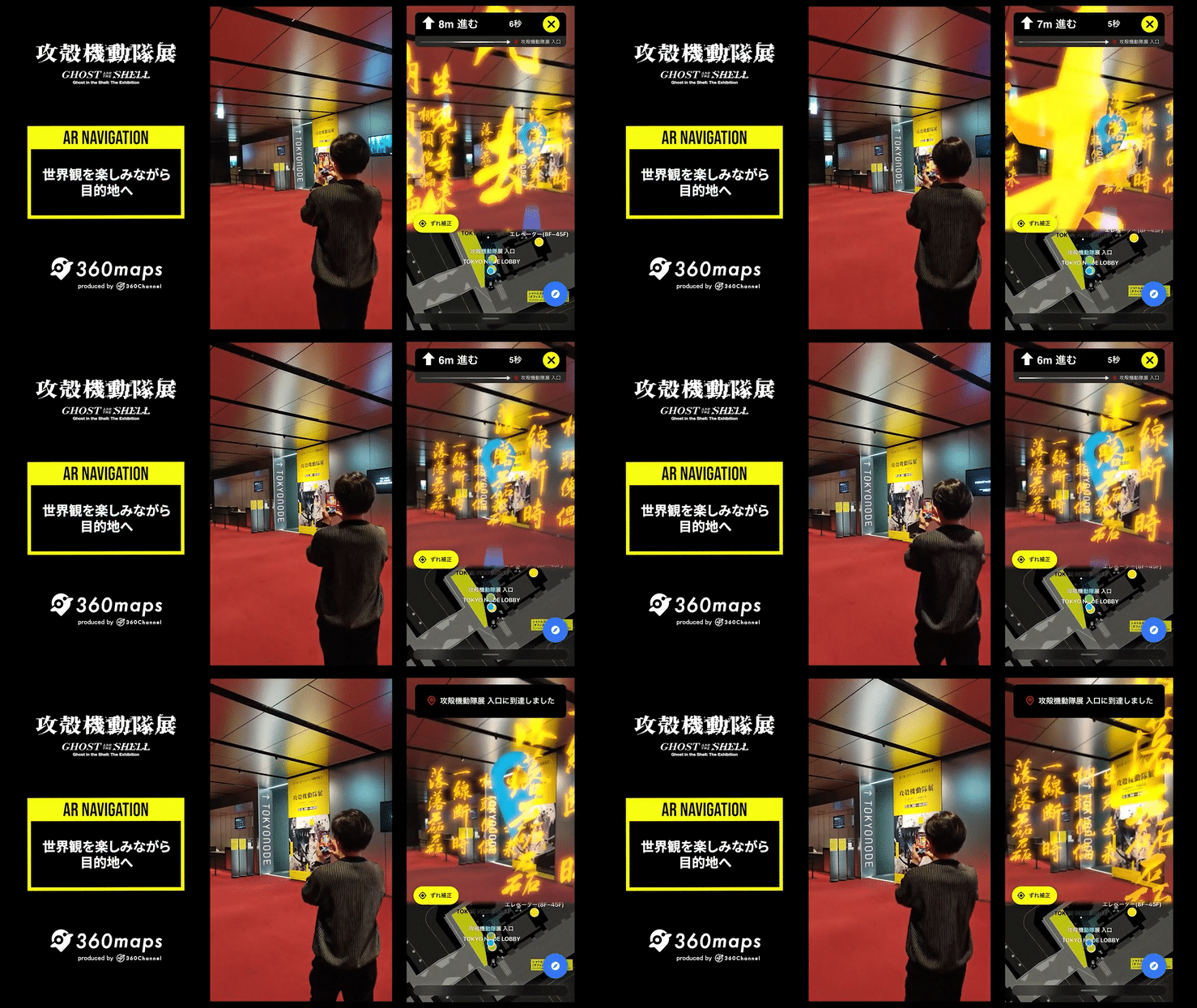
Key learnings
A few principles emerged from the project that translate well beyond this specific build:
- Tie the experience to the world, not just the wayfinding. The reason this worked is because the AR wasn't bolted on. It belonged to the franchise as much as the physical exhibition did.
- Design for the journey, not just the touchpoints. Treating the venue as one connected spatial system, rather than a string of isolated AR triggers, made the whole thing feel deliberate.
- Make the entry point invisible. The fewer steps between curiosity and engagement, the higher your activation rate. WebAR is genuinely the right tool for that job.
- Plan for the boring stuff. Concurrent access, varying lighting, signage placement — none of it is glamorous, but it's what separates a project that works on launch day from one that doesn't.
Looking ahead, 360Channel sees room to push further: refining onboarding flows, adjusting AR pacing based on real-time visitor behaviour, and using dynamic content to make each journey feel more individualised. The model is built to scale beyond exhibitions into commercial complexes, tourist destinations, and any venue where movement and meaning meet.
Beyond the exhibition
The Ghost in the Shell project is one of the more theatrical things 360maps has done, but it's not the whole story. The platform has also been deployed for the Akasaka Rally: Edo Sasuke, a city-wide mystery-solving game that uses AR to overlay scenes from Edo-era Tokyo onto the modern streets of Akasaka, and as a permanent navigation layer at Toranomon Hills Station Tower itself, where Mori Building uses it to guide visitors through one of the largest mixed-use complexes in the city.
Ready to build something that moves people?
360maps is a great example of what's possible in Mattercraft. If you're thinking about how to bring storytelling, wayfinding, or both into a physical space, whether your goal is to entertain, guide, or some interesting combination of the two, Mattercraft gives you the tools to do it on the open web, no apps required.
Start a free 14-day Zapworks trial and see what your space could become.
 Dave Mather
Head of Marketing